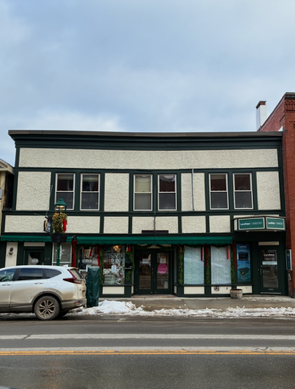
 The George H. Cleveland Building at 25 Main Street, constructed in 1892 and expanded in 1909, stands as a key contributor to Camden, Maine’s Great Fire Historic District.
This two-story, frame vernacular structure, reflecting Commercial Style architecture with its rectilinear design and light stucco facade, embodies the resilience and evolution of the area following the devastating Great Fire of November 1, 1892. The fire, which originated in Cleveland’s lofty, wooden general store, destroyed much of downtown Camden, including his initial business.
As a son of Harvey H. Cleveland, who owned the Union Store, George Cleveland was a staunch believer in Camden’s potential as a summer resort, having built the Lake City Inn on Lake Megunticook in 1892—though it burned down in 1895, sparking a cottage-building boom. After the 1892 fire, Cleveland swiftly rebuilt a temporary one-story frame building at 25 Main Street, reopening before Christmas to serve the community reliant on his diverse stock of groceries, hardware, provisions, and more.
The Panic of 1893 forced him to patch and expand rather than replace it fully. In 1896, contractor Spencer Mero raised the building to the newly elevated street level and updated the facade. By 1909, Cleveland added a second story, moving hardware upstairs, and tied the south wall into the Hodgman Block, with the front stucco abutting it and the Camden Grist Mill, though the second-story wall stops short due to the mill’s overhanging eaves. The first floor features a large storefront with plate-glass windows and a recessed double door, while the second story showcases exposed half-timbering and a mix of double-hung and stucco bays, reflecting the districts post-fire architectural recovery.
The building’s rear, with four stories due to its position below Main Street, overlooks the Megunticook River falls, a channel running to the harbor, and a wooden walkway on pilings, adding to its historic charm. In 1914, Cleveland sold the business to Jessie Hosmer, a high school graduate who had worked there since 1904. Hosmer, with partner Bertha Clason, transformed it into The Village Shop, installing large plate-glass windows and pioneering a gift shop selling stationery, china, books, crafts, toys, and penny candy—catering to Camden’s growing tourist trade. This innovative shift helped cement the building’s role in the districts commercial revival.
The Village Shop thrived for over a century, adapting through economic shifts, adding embroidery and Maine souvenirs until its closing in December 2022.
Today, A Little Moore occupies the storefront, offering sustainable women’s fashion and artisan goods, preserving the building’s legacy within the Great Fire Historic District.
This evolution mirrors the district’s journey from a fire-ravaged past to a vibrant, tourist-friendly present, with the Cleveland Building’s architecture and history standing as a testament to that resilience is owed by third generation Montgomery family.